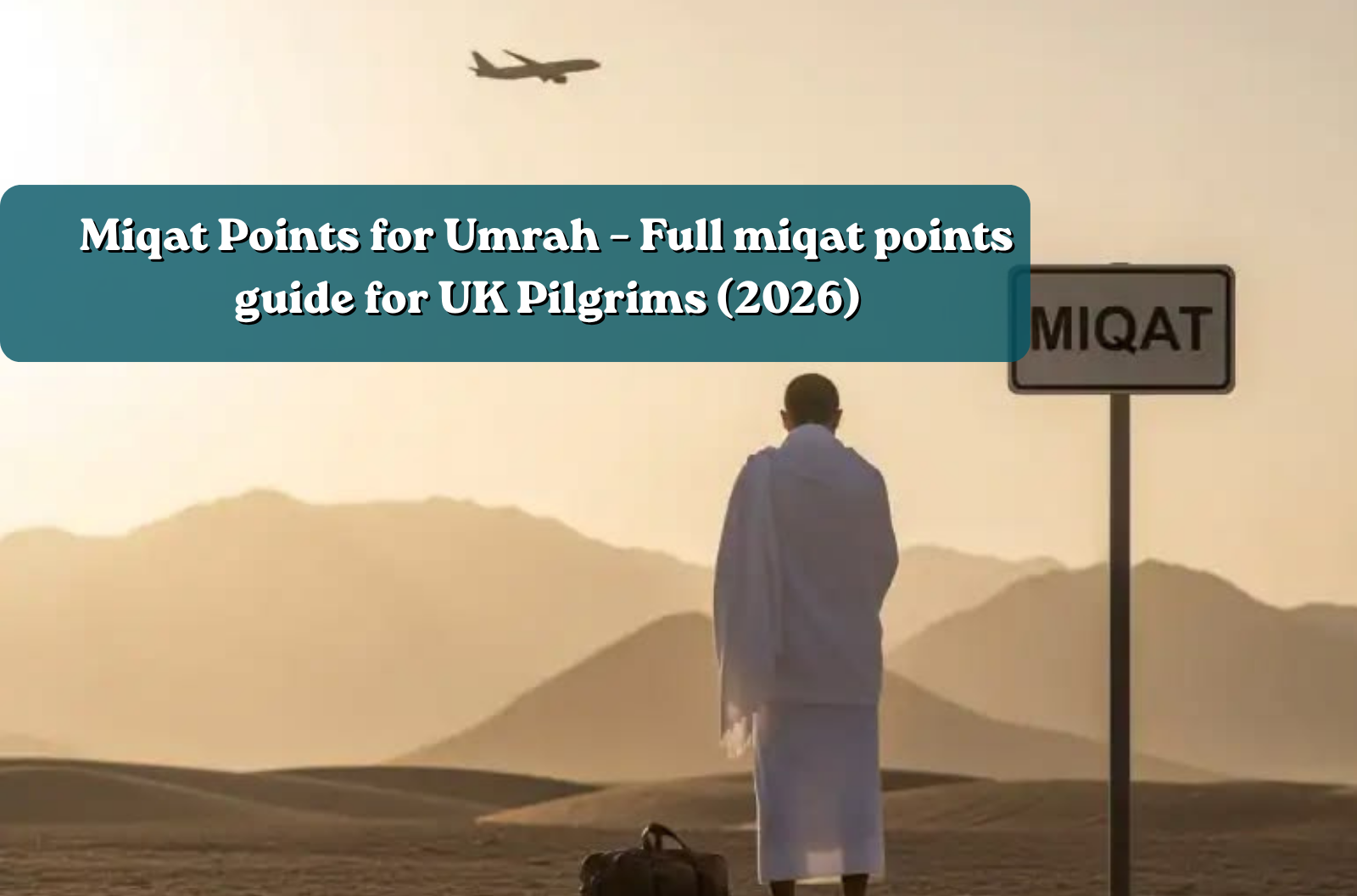
Embarking on Umrah from the United Kingdom is a profound spiritual pilgrimage, yet the realities of modern commercial aviation introduce unique logistical and jurisprudential challenges. Chief among these is navigating the Miqat points for Umrah, the sacred geographical and aerial boundaries established by Islamic law that designate precisely where and when a pilgrim must enter the consecrated state of Ihram.
For UK travelers flying thousands of miles across international airspace, crossing a Miqat line does not happen on foot or aboard a camel caravan; it occurs at 35,000 feet while traveling at speeds exceeding 500 miles per hour over the Red Sea or the Arabian Peninsula. Passing these boundary lines without being in Ihram carries serious legal consequences in Islamic jurisprudence (Fiqh), including the requirement of a compulsory expiatory sacrifice (Dam). This guide provides a definitive, practical, and scholarly-grounded breakdown of every Miqat point for Umrah, how major UK flight corridors intersect them, how to execute in-flight Ihram seamlessly, and how to avoid costly logistical mistakes.
What Is a Miqat points for Umrah? Theological Significance and Legal Rulings
The term Miqat (plural: Mawaqit) literally denotes an “appointed time or place.” In Islamic jurisprudence, it refers to specific geographic stations designated by the Prophet Muhammad (peace be upon him) that mark the sacred perimeter of Makkah. Anyone traveling toward Makkah with the explicit intention (Niyyah) of performing Hajj or Umrah is religiously forbidden from passing these points without first entering the state of Ihram.
The legal necessity of entering Ihram at or before the Miqat is derived from authentic prophetic traditions (Ahadith). When a pilgrim crosses this boundary in Ihram, they enter a state of heightened spiritual devotion governed by strict prohibitions—such as refraining from cutting hair or nails, wearing tailored or stitched garments (for men), applying scent, or engaging in marital intimacy.
Core Principles of Fiqh Regarding the Miqat
- Mandatory Boundary (Wajib): Islamic scholars across all four major Sunni schools of thought (Hanafi, Maliki, Shafi’i, and Hanbali) unanimously agree that assuming Ihram at or before reaching the designated Miqat is compulsory for anyone intending Umrah or Hajj.
- Aerial and Maritime Alignment (Al-Muhadhah): The legal boundary is not confined to the physical surface of the earth. Jurists have established that the boundary extends vertically into the airspace directly above each land station and diagonally along parallel flight lines (Al-Muhadhah). Airline passengers are subject to the same rulings as overland travelers.
- Prior Entry Is Permitted: A pilgrim is fully permitted to enter the state of Ihram before reaching the Miqat points for Umrah—such as at their home in the UK or at London Heathrow prior to departure—provided they maintain the state of Ihram and its restrictions throughout the journey. However, delaying the intention (Niyyah) until after crossing the line is a legal infraction.
The Six Primary Miqat Locations Explained
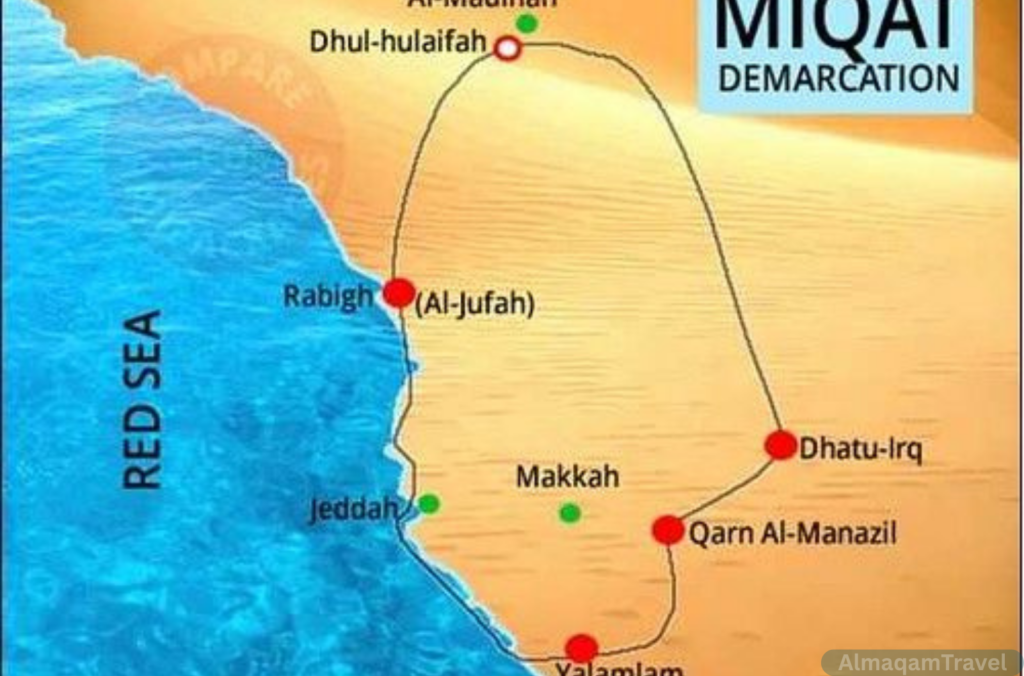
The Prophet (peace be upon him) designated four primary boundary stations; a fifth was formally recognized by the second Caliph, Umar ibn al-Khattab (may Allah be pleased with him), for travelers originating from eastern territories, and a sixth local boundary serves those already within Makkah’s sacred precinct.
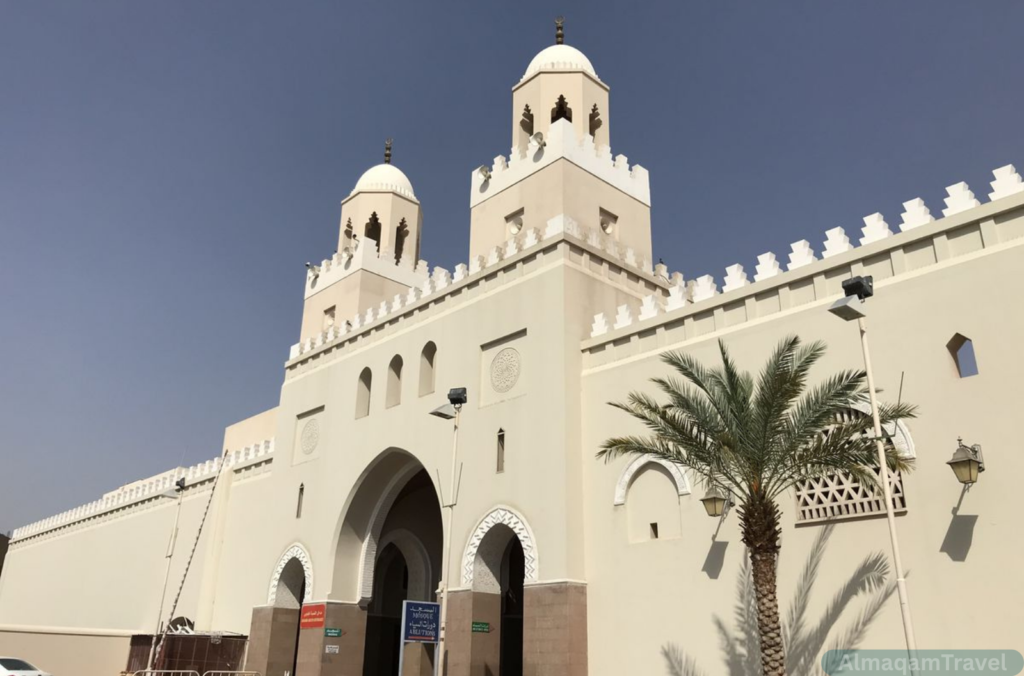
1. Dhul Hulayfah (Abyar Ali)
- Geographic Location: Located approximately 18 kilometers south of the Prophet’s Mosque in Madinah and 410 kilometers north of Makkah.
- Distance to Makkah: 410 km (the furthest Miqat from Makkah).
- Who Uses It: Residents of Madinah and international pilgrims (including UK travelers) who land in Madinah first and subsequently travel south to Makkah by train, bus, or private vehicle.
- Infrastructure: A modern mosque complex featuring thousands of shower stalls, expansive ablution facilities, retail shops for Ihram sheets, and designated prayer halls.
2. Al-Juhfah (Near Rabigh)
- Geographic Location: Situated 182 kilometers northwest of Makkah, close to the coastal city of Rabigh along the Red Sea.
- Distance to Makkah: 182 km.
- Who Uses It: Historically, the Miqat for pilgrims from North Africa, Egypt, and the Levant. Today, it serves as the primary aerial Miqat for non-stop direct flights from the UK, Western Europe, and North America heading directly to King Abdulaziz International Airport in Jeddah.
- Practical Note: Because historical Al-Juhfah fell into ruin centuries ago, the adjacent coastal town of Rabigh (located slightly prior to the historical site) is commonly used as the land reference. Direct UK flight corridors cross the Red Sea parallel to Rabigh.
3. Qarn al-Manazil (As-Sayl al-Kabir)
- Geographic Location: Located 80 kilometers east of Makkah, near the mountain resort city of Ta’if.
- Distance to Makkah: 80 km.
- Who Uses It: Travelers coming from Central Saudi Arabia (Riyadh), the Gulf Cooperation Council (GCC) countries (UAE, Qatar, Kuwait, Oman), and pilgrims transit-connecting through Gulf airline hubs (such as Dubai, Doha, or Abu Dhabi) on their final approach to Jeddah.
- High-Altitude Station: Features a mountain station called Wadi Maharim, utilized by road travelers descending from Ta’if.
4. Yalamlam (Sa’diyyah)
- Geographic Location: Located roughly 100 kilometers southeast of Makkah.
- Distance to Makkah: 100 km.
- Who Uses It: Pilgrims traveling from Yemen, South Asia (India, Pakistan, Bangladesh), Southeast Asia, and southern maritime shipping routes across the Indian Ocean.
5. Dhat ‘Irq (Al-Aqeeq)
- Geographic Location: Located approximately 90 kilometers northeast of Makkah.
- Distance to Makkah: 90 km.
- Who Uses It: Pilgrims traveling overland or by air from Iraq, Iran, Central Asia, and northern desert routes across the Arabian Peninsula.
6. Masjid Aisha (Tan’im) – The Local Miqat points for Umrah
- Geographic Location: Situated 7.5 kilometers north of the Grand Mosque (Masjid al-Haram) within the administrative limits of Makkah.
- Who Uses It: Residents of Makkah and international pilgrims who are already inside Makkah and wish to undertake an additional (subsequent) Umrah during the same trip.
Comparative Guide: UK Routes, Airlines, and Miqat Logistics
The following table outlines the exact logistical details for each standard flight and transport combination available to UK pilgrims.
| Flight Route / Transport Mode | Common Airlines / Carriers | Applicable Miqat | Where to Put On Garments | Where to Formulate Niyyah & Talbiyah |
|---|---|---|---|---|
| Direct to Madinah | Saudia (LHR to MED) | Dhul Hulayfah (Ground) | At Madinah hotel or Haramain Train Station | At Masjid Dhul Hulayfah or on Haramain Express train |
| Direct to Jeddah | Saudia, British Airways (LHR/LGW to JED) | Al-Juhfah (Aerial) | UK Airport lounge (Heathrow / Manchester) or early in flight | In-flight, ~30-40 mins before landing, upon the captain’s announcement |
| Via Gulf Hub | Emirates, Qatar Airways, Etihad, Gulf Air | Qarn al-Manazil (Aerial) | Transit airport lounge (Dubai, Doha, Abu Dhabi, Bahrain) | In-flight during Leg 2 before crossing the Arabian Peninsula line |
| Via Istanbul | Turkish Airlines, Pegasus Airlines | Al-Juhfah (Aerial) | Istanbul Airport transit lounge/prayer rooms | In-flight on Istanbul-Jeddah leg upon reaching the Red Sea corridor |
| Madinah to Makkah (Train) | Haramain High-Speed Express Railway | Dhul Hulayfah (Ground line) | At Madinah hotel before arriving at the train station | Onboard train immediately following the automated Miqat audio alert |
| Madinah to Makkah (Road) | Private Taxi / VIP Coach Tour | Dhul Hulayfah (Abyar Ali Mosque) | At Masjid Dhul Hulayfah shower facilities | Inside Masjid Dhul Hulayfah after praying 2 Raka’at Nafl |
Make Your Umrah Journey Comfortable with Almaqam Travel UK
Umrah is not just another holiday; it is a special opportunity to strengthen your relationship with Allah and experience the beauty of the holy cities. For women travelling from the UK, proper preparation is particularly important. From understanding Ihram rules to arranging flights, accommodation, and transport, every detail deserves attention. At Almaqam Travel UK, we aim to make your Umrah planning easier by offering Umrah travel UK options to suit different budgets and requirements. Whether you are planning a journey with your family, travelling with friends, or arranging your first Umrah, choosing a suitable package can help you focus more on your spiritual experience.
Explore our Umrah Packages UK and start planning your spiritual journey with Almaqam Travel. Book your Umrah journey today and take the first step towards a memorable spiritual experience.